Alan Dye, Apple, Meta, and Taking Out the Trash
All’s well that ends well, isn’t it?
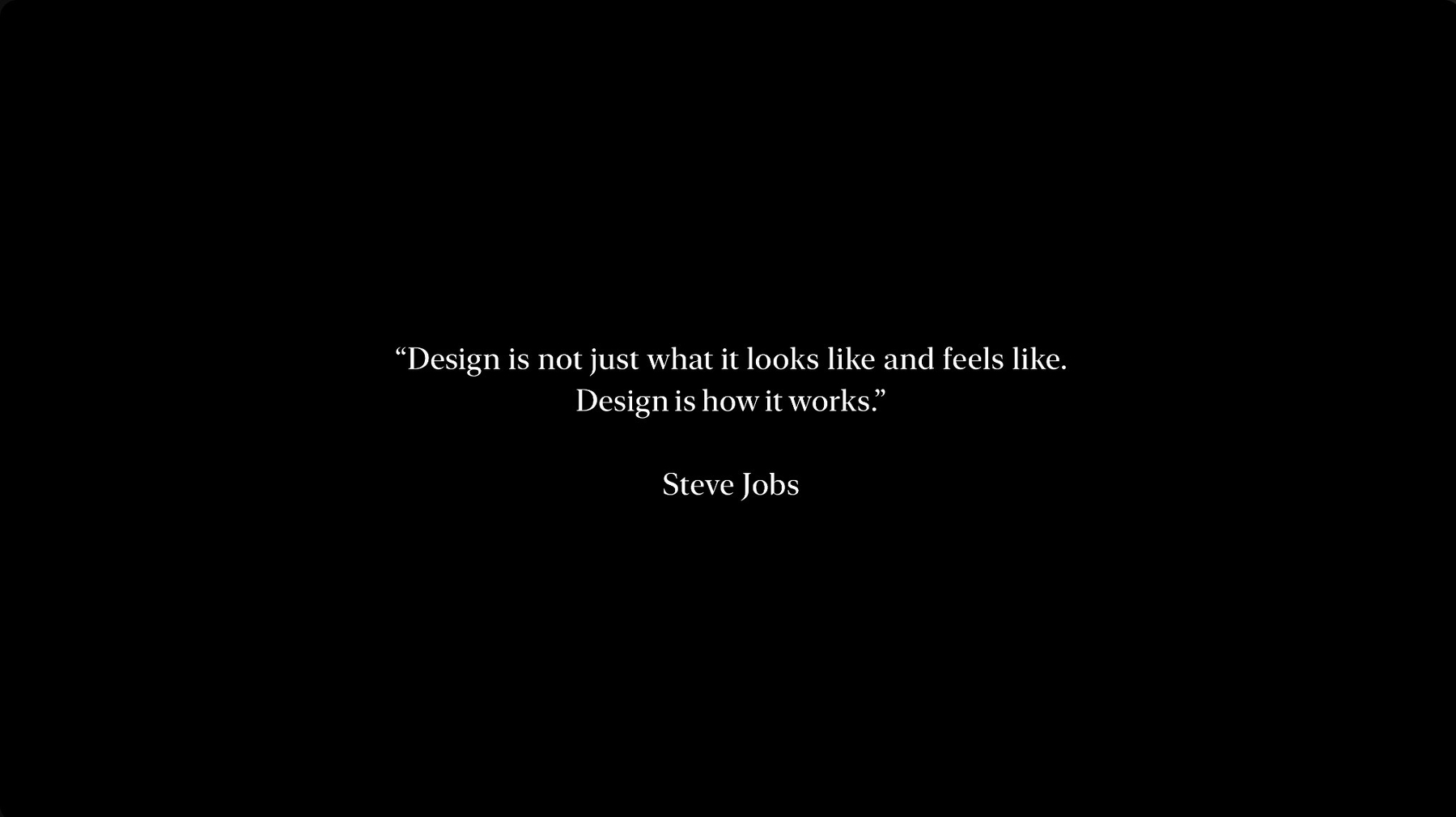 A quote from Steve Jobs, presented at Apple’s September 2025 event. Image: Apple.
Bloomberg on Wednesday reported that Alan Dye, Apple’s head of user interface design for over a decade, would depart to work at Meta Reality Labs. The news was confirmed by Tim Cook, the company’s chief executive, who said Stephen Lamay, a longtime designer for the company, would assume Dye’s role. Bloomberg’s report was heavy on the “Meta rules, Apple drools” narrative1, but if anything, that’s a reflection of what Dye has done to Apple during his tenure. The average IQ of both companies has increased. (Thanks to Twittgenstein on X for this wonderful adaptation of this quote.)
It’s safe to say I am not a fan of Dye’s work. I, much like Jason Snell at Six Colors, refrain from excessive personal attacks in my writing, but this is one of the few exceptions. Dye has overseen many inventive projects at Apple, namely iPhone X’s gesture-based navigation system and iPhone 14 Pro’s Dynamic Island, both designs that I have commended on numerous occasions. But that concludes the list of thoughtfully designed interfaces Dye has produced.
macOS 11 Big Sur was a clear design regression from previous versions of macOS. It obscured clarity to “make more room for content,” an adage Dye has used ad nauseam to the point where it has become meaningless filler. It hid nearly all important context behind some action, whether it was moving the cursor over a segmented control for more context, swiping to reveal more actions in a menu, or increasing button spacing so much that it became a nuisance to use the mouse. macOS Big Sur objectively made the Mac a worse computing platform, even if it brought feature and design parity across Apple’s operating systems. Apple, under Dye’s leadership, has failed to comprehend the sanctity of the Mac operating system: that it is fundamentally different from iOS and must be treated with a different level of precision.
Under Dye’s design leadership, the Mac has shipped with lowest-common-denominator apps pulled from iOS and transplanted onto a larger screen. My favorite example is Home, which is perhaps one of the worst first-party apps ever designed on any version of macOS. It is hilariously pitiful, so much so that it lacks support for even basic keyboard shortcuts and requires dragging with the mouse to change the brightness level of a light bulb. Another regression applies to the Home app on all platforms: tapping a device tile navigates to the detail view for the device, but tapping the icon switches the device on and off. This is not visually indicated anywhere, and it isn’t even consistent across device types.
This abject laziness and incompetence isn’t limited to the Home app. The double-tap-to-invoke-Siri gesture introduced in iOS 18 is so prone to accidental triggers that any reasonable person would conclude it was simply never tested by Apple designers. The Safari redesign in iOS 15 and macOS 12 Monterey was perhaps some of the most embarrassing design work from Cupertino since the infamous 2013 Mac Pro. In iPadOS and macOS, it was so hard to see which tab was selected that someone made a Safari extension to mark the selected tab with a colored sliver just so it was legible during the beta process. And the iOS version hid the refresh button underneath a context menu for over half the beta period until the uproar online was so loud that Apple was forced to change it.
And none of this considers Liquid Glass, which is so unbearable in some places that I had to write an article documenting everything that was wrong with it. Legacy macOS app icons are now destroyed by a gruesome gray border, encapsulating them in a rounded rectangle. The gorgeous tool-inspired designs that once made the Mac whimsical and fun are now extinct, replaced by nondescript, mundane app icons that don’t even pay homage to the original versions. Liquid Glass is still unreadable in many places, and Apple knows this: If a notification appears on the Lock Screen, iOS dims the Lock Screen wallpaper so the text is legible. And Dye’s solution to this conundrum was not to go back to the drawing board and rethink the Liquid Glass material, but to add a truly hideous Tinted option that looks like Google designed it.
Liquid Glass is completely nonsensical on the Mac. It nonsensically mirrors content in sidebars, it nonsensically moves elements to the bottom of the screen like in Music, and it nonsensically changes the corner radii of windows depending on their navigation structure. Every year, Dye rounds window corners even further despite the fact that no Macs ship with truly rounded corners. Why must windows be rounded this severely, and why is every single window’s radius different across the system? There is no consistency, no taste, no respect for the craftsmanship of the operating system. macOS has lost every ounce of class it once had, and it has been whittled down to a disorienting mess of iOS-like controls mixed with designs that feel like they’ve taken inspiration from Windows Vista.
Alan Dye is objectively horrible at his job, and it is a great boon to Apple that his tenure is over.
As Steve Jobs said, “Design is not just what it looks and feels like. Design is how it works.” Dye loves this quote so much that it was prominently featured at the beginning of the September iPhone event, and he has no right to love it. Dye is a Jobs cosplayer, not a protégé. He takes ideas from Apple’s post-Jobs Jony Ive era and applies them in all the wrong places. It’s like handing a wild animal a machete — he has all the ability to design some of the world’s most used and beloved operating systems, and none of the talent.2 Jobs and Ive, Apple’s former chief designer, were such a great duo because they complemented each other so well. Ive would have these outlandish design ideas, and Jobs would rein them in. Jobs knew how to make good technology, and Ive knew how to make it beautiful.
Apple lacks technical leadership in the C-suite. Cook probably couldn’t figure out how to exit Vim to save his life. The situation in Cupertino is so bad that Luca Maestri, Apple’s former chief financial officer, not only had the power but the final say in rejecting a technical team’s request for graphics processing units to train artificial intelligence models. Not the leader of the company, not a member of the technical staff — the leader of the accounting department with a degree in economics. Therefore, it comes as no surprise that Dye’s shenanigans went completely unchecked. Craig Federighi, Apple’s software engineering chief, had the power and qualifications to put Dye in check, but he simply failed. Federighi’s failure to oversee software design (Dye) and engineering (John Giannandrea, Apple’s head of machine learning, who just recently announced his retirement) will go down as one of the most catastrophic missteps in Apple’s recent history.
As John Gruber writes at Daring Fireball, Dye has no technical experience, not even in designing user interfaces or computers. He’s a fashion executive who worked for Kate Spade, a clothing design brand. Someone like that either needs a technical supervisor (Federighi or a Jobs-like figure) or must be relegated to a lower-level position working on design prototypes. It is galling for Apple that he was appointed to such a prestigious role, and the steeply declining quality of Apple software, especially in this decade, is proof that he doesn’t fit there.
As for Stephen Lamay, Dye’s replacement, I have no idea who he is. Maybe he’s a good designer, maybe he isn’t. But he does have technical expertise, something sorely needed at higher levels of Apple leadership. Ben Hylak, a former Apple designer who now works for an AI startup, says Lamay is “by far the best designer I have ever met or worked with in my entire life” — high praise from someone who worked under Dye and can now speak candidly. And if Gruber’s sources are to be believed, Lamay is universally liked internally. These are good indicators of competency: Apple employees, on many occasions, have criticized the leadership of Giannandrea and Robby Walker, a leader of the Siri team under Giannandrea. Both figures have left the company since. When an executive is despised internally, it isn’t a good sign.
The rumored “Snow Leopard”-style bug-fix update coming next year will be a true test of Lamay’s leadership. With technical guidance, he must bring Apple’s operating systems together, which are currently in an unstable state. They feel like a mélange of poorly integrated user interface concepts — especially macOS, whose design is unbearable to look at and use. Time will tell if Lamay is taking the pastiche route to Dye’s leadership, or if he throws all of this in the trash and works to restore Apple software to its former glory.
It doesn’t surprise me in the slightest that Dye has chosen Meta as his next employer. (And yes, I’m certain Dye chose Meta, not the other way around.) The two go together like a moth to a flame. Mark Zuckerberg, Meta’s chief executive, has been poaching top talent from his major Silicon Valley competitors since the beginning of this year, even offering pay packages of up to $100 million. Meta is short on talent, in both senses of the word: it does not have the inherent aptitude (via company culture) to make anything wonderful, nor the people interested in accomplishing anything spectacular. People work at Apple not for extravagant bonuses or work-life balance, but because they truly believe in the company’s mission. It’s unique in that sense. People who work at Meta only go there because they pay $100 million — the same goes for Dye.
Dye never truly believed in the Apple philosophy of design. I don’t mean this in the “Severance”-esque “there’s more to work than life” way, but that he doesn’t understand what makes Apple special. On Wednesday, as the news of his departure hit the internet, he posted to his Instagram story a quote from Jobs telling people to “not dwell on” a job for too long if you “do something and it turns out pretty good.” That is truly in dismal taste, almost like one last middle finger pointed toward Apple’s worship and respect for Jobs’ work. Nobody at Meta believes a thing Jobs said, but Apple employees — the ones Dye is leaving behind in Cupertino — certainly do, and using a Jobs quote in this way distorts the true meaning of Apple’s design work.
Meta Reality Labs, these days, makes AI wearable products, but it wasn’t too long ago that it was peddling the Fisher-Price metaverse. Zuckerberg was so bullish on the metaverse that he even renamed his company after it. What was once Oculus — talented makers of the finest virtual reality products — turned into Reality Labs, a division that is mostly focused on bringing Meta AI into the real world. Meta AI, however, is comically worthless. Llama, the company’s flagship large language model, does extremely poorly on all benchmarks compared to its competitors, and the technology is mainly used by elderly people on Facebook to reply to posts and share truly atrocious AI-generated videos. Alexandr Wang, Meta’s head of AI, whom it spent $14 billion hiring, truly nailed the Meta AI coffin shut.
Dye’s new job at Meta reminds me of Zuckerberg’s hiring of Wang, who has contributed virtually nothing meaningful to the company. Wang’s role at Meta is presumably quite significant: He’s the head of the Meta Superintelligence Labs, a sister division to Meta Reality Labs. (In Meta parlance, a “lab” is a division that specializes in developing new technology before handing it over to a consumer product team, like Instagram, for final implementation.) Dye’s role as chief designer for Meta Reality Labs would be roughly analogous to Wang’s, since design is one of the most difficult problems VR and augmented reality devices face. All of this leads me to believe Dye won’t be successful in this new role, despite the power he is given, similar to Wang.
Meta is a disoriented company without product taste or clear direction. It goes along with the market. Many of Apple’s biggest supporters who read my work have been quick to point out to me that Apple hasn’t suffered materially due to its lack of a successful AI product because its core hardware has been successful, and they’re right. The same goes for OpenAI, which pioneered the AI boom in 2022 with the launch of ChatGPT and has its eyes set on total domination in that field. Google has chipped away slowly at AI for the better part of two decades, and it too has found success there. All three of Meta’s most important competitors have decided on a path forward. Meta hasn’t converged on a field yet, and it never will — it started with social networking, then moved to the metaverse because it missed out on owning a major mobile platform, then haphazardly shifted to AI once it became apparent that it would be profitable. This isn’t a successful business strategy.
Zuckerberg is not entirely incompetent, but he’s certainly confused, and the sentiment within Meta is that everyone else is, too. They’re certainly proud of their work, but they never know what’s next, and there’s never a hint of altruism anywhere. Meta’s hiring strategy stems from a lack of direction, and Dye’s appointment is the latest example in Meta’s corporate messiness.
-
I can’t believe Gurman is still pearl-clutching about this. Apple is finally taking out the trash, and anyone who knows about the company for more than 10 years will (appropriately) be elated by this news. Apple isn’t hemorrhaging talent; it’s taking out the trash. ↩︎
-
Not all qualifications, though. ↩︎