
At I/O, Google Hopes to Ditch the Humans
Apps, harnesses, and the singularity
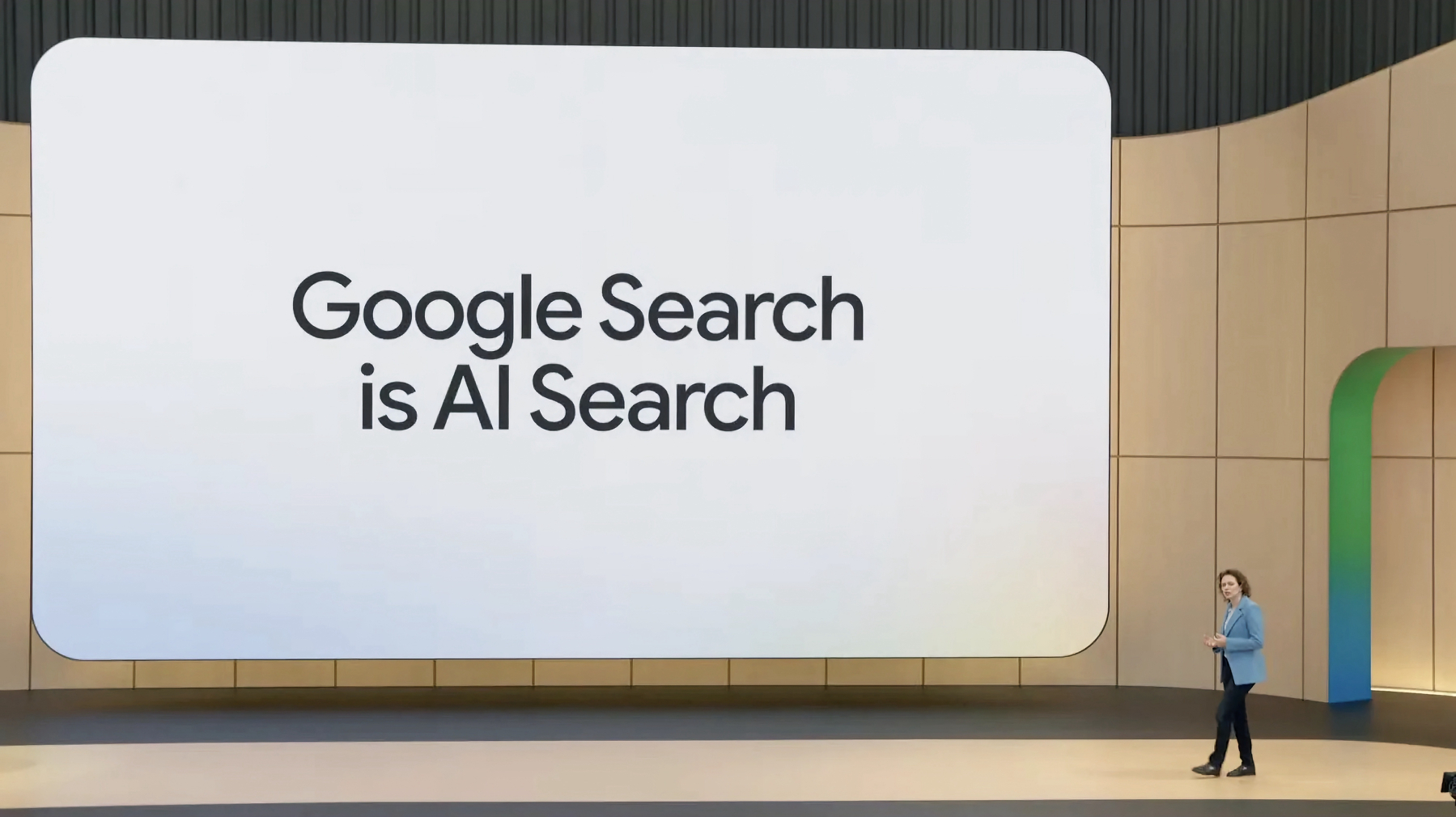 Who asked for this? Image: Google.
I think Google has landed on a solution to the shortcomings of Google Search: Gemini.
During Google’s I/O developer conference on Tuesday, where the company announced updates to its products, Gemini and artificial intelligence once again took center stage. The company, live from its headquarters in Mountain View, California, released a smarter yet smaller large language model, Gemini 3.5 Flash, to better position Gemini in Google Search, its flagship product used by billions of people daily. It previewed new programming tools for developers, including a refreshed version of Antigravity, Google’s AI coding agent powered by Gemini. And it used that new coding harness to power a consumer-facing agent built into the Gemini app, called Gemini Spark, a system that runs in the cloud with access to a full computer to complete tasks autonomously on the web.
These are just a handful of announcements Google showcased during its Tuesday presentation, but I think they’re the most important because they illustrate an overarching strategy. Google wants to get people into Gemini, whether they’re programmers, casual Gemini app users, or Google Search users. At I/O this year, the company has fully committed to Gemini as the future of its search and generative artificial intelligence endeavors, and now hopes its waffling for the past few years hasn’t undermined the strategy. Google, more than any Silicon Valley technology company, has both users and ecosystem lock-in. Its job now is to capitalize on those users, provide a compelling product, and hope people stick with it.
Google has so far accomplished none of those objectives, but at least it now has a coherent product strategy. Gone is the haphazard mishmash of contrasting products — Gemini, AI Mode, Gemini Agent, Project Mariner, Google Assistant, Gemini on Android, the Gemini command line interface, and the plethora of other consumer projects Google has released since the start of the AI boom in 2023. The company’s core product strategy revolves around Gemini — the Gemini app, that is — and it took the first steps on Tuesday to funnel the billions of Google Search users to Gemini over the coming years.
Product coherence aside, I don’t find the mission all that compelling. The new Antigravity harness is lackluster and leaves much to be desired compared to Claude Code and Codex, its main competitors. The new model is also smaller than the other flagships, packing in fewer parameters, or “intelligence.” AI Mode in Google Search, in my eyes, is a complete failure and distraction from the inaccurate, sloppy AI Overviews that have littered Google Search in recent years. The Gemini app, including Gemini Spark, seems impressive, but is it worth axing web search for? And Google still has not made clear how publishers can capitalize on the boom. With the company’s strategy defined by Gemini, links to external websites will only become sparser. What happens to the open web as a result of these changes? What happens to humans as a result of these changes?
There are many adjectives one could use to describe Google I/O this year: boring, nonchalant, disappointing. I’d say the best one, though, is clarifying. But the lack of ambiguity here might not be comforting.
Search
Google positioned this year’s updates to Google Search as the largest since the search engine’s launch over 25 years ago. I agree, not because the announcements were that significant, but because the core search product hasn’t changed much since its inception. At the center of Google Search, now and for the past two and a half decades, is a list of blue links to websites. Over time, what has appeared at the top of and beside those results has varied. Initially, it was nothing — just the links, and nothing more. As Google grew and made money, those spaces became home to lucrative advertisements, some of the best places to promote a product or business on the entire internet. As Google’s machine learning models developed and the Knowledge Graph grew, so-called “featured snippets” occupied the top of the page, perhaps with images and other visual aids.
Today, at the top of almost every Google Search page is an AI Overview, generated by one of Google’s Gemini Flash models. Beginning Tuesday, Gemini 3.5 Flash, the latest model, will generate these overviews. AI Overviews replace featured snippets and often prioritize speed over correctness. Initially, they used inferior models to deliver quick responses — now, they use a better model but with a low, or zero, thinking budget. The model is encouraged to deliver a fast response without checking its work. The result is that AI Overviews are quantitatively poor at both generating correct answers and summarizing work on the internet. A New York Times investigation into Google’s AI Overviews found that the latest version, running on Gemini 3.1 Flash, produced completely fabricated answers 9 percent of the time. Google’s own research pegged the number much higher, at 28 percent.
More worryingly, the overviews’ answers tend not to be grounded in sources, increasing the possibility of hallucinations when asked questions that require fresher knowledge. The Times investigation reported that, when using Gemini 3.1 Flash, Google’s AI Overviews did not provide a source for 56 percent of correct answers. This is almost certainly not a user interface glitch — the model relies heavily on information stored in its own parameters rather than summarizing the information found in search results, as the latter takes more time. The model must open each of the links, store the content in its context window, then summarize it. The Times investigation further stated that the AI Overview occasionally identifies a “reliable website but seems to misinterpret its information.” At other times, the AI Overview relies on Facebook or Reddit posts, especially when reputable content is sparse.
This is the primary experience most people have with generative artificial intelligence. Google Search is used by billions of people daily, and Gemini is used by around 900 million, per Google. AI Overviews are, by every heuristic measure, much less accurate than even Gemini 3.1 Flash in the Gemini app harness, let alone frontier models such as Gemini 3.1 Pro. Google is astutely aware of the limitations of such overviews, so it released AI Mode alongside AI Overviews last spring. AI Mode appears to act like Gemini with enhanced web search capabilities. For one, it always searches the web, whereas the Gemini app does not. It also offers the larger models, like Gemini 3.1 Pro, even to free users. AI Mode is accessible via the AI Overview by simply tapping on the summary — doing so will generate more content, albeit more slowly. Users can also ask follow-up questions from this mode.
Google said Tuesday that around one billion people use AI Mode monthly, a statistic I view with skepticism. I believe Google is counting people who tap on AI Overviews for more information as AI Mode users, which is technically true but disingenuous, because tapping on the summary does not regenerate the response for accuracy — it simply adds more information. Anecdotally, I have yet to hear from a single person outside tech circles who uses AI Mode regularly by clicking the AI Mode button in Google Search. People who are likely to reach for an AI-generated response, as opposed to passively consuming a summary, tend to use Gemini instead. I don’t doubt that 900 million people use Gemini monthly — the app appears on par with ChatGPT in popularity.
All of this is why I tend to believe the AI features in Google Search are, at best, a bandage for a self-inflicted problem and, at worst, an abysmal failure. For one, AI Overviews are objectively incorrect more than any other AI product, including the ever-popular ChatGPT free tier. They give large language models an unnecessarily bad reputation, and they give people incorrect information. That does not further Google’s stated mission of “organizing the world’s information and making it useful.” And AI Mode, buried under a button or summary, still is not nearly as accurate or useful as the Gemini app itself. Neither of these features promotes the overall health of the open web, a dying sector of the technology industry whose concerns Google continues to dismiss. One day, we will live in a world where publishers will stop publishing and the vast majority of content will be written by LLMs.
We are already seeing the effects of the content vacuum today — Google’s AI Overviews refuse to link to publishers because there are no publishers to link to. And if there are no publishers, there’s no training data. Google’s AI search endeavors have refused to solve the fundamental problem with Google Search: poor results stemming from search engine-optimized filth. Instead, they are merely accelerating the problem’s metastasis, discouraging the publication of reliable information online. They’re inaccurate, and they make their training data inaccurate because there isn’t enough good data to train on anymore. There aren’t enough good sources to link to. Google Search is heading toward an infinite death spiral.
Again, Google is astutely aware of this, which is why it must transition search away from links. Google does not want people to visit other websites — it wants them to interact with its chatbot, Gemini, to produce more training data. This is a short-term solution to a long-term plague, but it is what Google has ultimately decided on. It hopes to never have to rely on publishers because Gemini will become so good one day that it creates the data for itself. Theoretically, with this approach, Gemini will not have to rely on Reddit threads for advice — it will be “smart” enough to reason through a problem by itself and come up with an answer. Google wants to cut the publisher out of the scenario entirely. If publishers want a part, they can advertise to have their products or links favored within Gemini chats.
Google keeps referring to this idea by saying people are typing “longer, more detailed queries” into Google Search. That might be true, but I also think it’s at least a bit of an exaggeration. Google wants people to be frustrated by the “10 blue links,” subconsciously begin treating Google Search like Gemini, then transition those users to AI Mode first and Gemini later. Once they’re in Gemini’s territory, using smarter models with more comprehensive reasoning traces, the model can act as an agent, scouring much older, more niche information for an answer. It is no longer forced to rely on Reddit threads or social media posts, the links most likely to float to the top of search results. It will no longer need a publisher to report the news. The agent becomes the journalist or the DIYer or the YouTuber sharing niche knowledge. This might seem like an absurd idea, but it’s very much where Google believes the internet is heading. Google wants the internet to be by agents and for agents — it does not want people to do the searching or the writing anymore. It is killing their traffic, and it is making publishers’ livelihoods impossible.
Framing Google’s Tuesday announcements in this light makes the overarching strategy abundantly clear. The Google Search bar, beginning Tuesday, will autocomplete queries to be longer and more sentence-like, similar in structure to a Gemini prompt. Autocomplete suggestions come from a bygone era, when PageRank, the algorithm Google Search uses to rank pages by their authenticity and relevance, used keywords and links to find appropriate websites. This is how SEO became such a vibrant industry — littering a website with the most commonly suggested keywords was a great way to get to the top of the page. Now, Gemini doesn’t rely on keywords — it needs a lengthy, detailed query to reason well.
When people enter the results, Google will automatically route them to AI Mode whenever it deems necessary to get people accustomed to waiting a while for responses. Google Search results are effectively instantaneous because nothing is generated. AI Overviews have struggled to meet this standard, but AI Mode has no such pressure for brevity or speed. AI Mode functions much like Gemini, and again, the end goal is to encourage people to use the mainline Gemini app and agents generally. AI Mode this year borrows many features from Gemini, including the Antigravity harness to write code and put together mini applets to explain concepts, for instance. It also includes an agent similar to Project Mariner that can interact with other websites autonomously. The point is to change people’s ideas about Search — it is no longer a place for people to find information.
This is what Google meant by “the biggest changes to Google Search.” Google is done with the 10 blue links, but it is also done with publishers, social media, and websites made by humans for humans. The open web, it hopes, is a thing of the past, to be replaced by agents that interact with each other. It does not even want people to shop online by themselves anymore — agents can instead navigate sites and purchase goods through the Universal Commerce Protocol. Google wants people to spawn agents across its products, including YouTube, AI Mode, and Gemini, to purchase products without user confirmation. Gemini will hunt for products based on user-set criteria, ensure each specification is met, and automatically place the order with a retailer. Project Mariner laid the foundation a year ago, and now, taking heavy inspiration from the Model Context Protocol, Google hopes people will trust their agents with their credit cards.
And that is where it becomes apparent that hardly anyone wants this. People want information on the open web; people do not want to give an agent their credit card. Fans of Google — who have reached out to me this week expressing their displeasure at my recalcitrance toward agentic search — point to the one billion people who “use” AI Mode and the 900 million who use Gemini. But those people don’t have a choice — Google has systematically destroyed the internet and web search and sold people the solution: AI Mode. Agentic products are useful on many occasions, but the rise of AI Mode sharply correlates with the unmistakable decline of Google Search. AI Overviews are objectively unhelpful. People, anecdotally, are frustrated with the quality of AI-generated responses on Google and the sheer number of unhelpful results cluttering the links. Traffic to publishers has dropped steeply while the demand for that content only seems to rise.
AI Mode is a failure; it is a symptom of a dying web. It is a solution to a problem Google created. This year’s I/O positions that solution as a bridge between the Google Search of yore and Gemini-powered agents that Google hopes to capitalize on.
Gemini and the Singularity
The most feature-rich of the Gemini-powered agents thus far — and the first to graduate from preview status — is Gemini Spark, an instance of Gemini 3.5 Flash running in the cloud via the rewritten Antigravity harness. Gemini Spark is Google’s answer to OpenClaw, and the first always-on agent that combines Personal Intelligence, computer use, and apps through the Model Context Protocol. Project Mariner, introduced in 2024, manifested itself in Gemini Agent, a computer-use tool that planted the seeds for an always-on agent that could perform tasks autonomously. Gemini Spark is a continuation of this endeavor, relying on the newer Gemini models’ improved tool-use capabilities to remain in standby forever. The agent is effectively given its own computer in the cloud — people can prompt it like Gemini Agent, but it can also work autonomously.
That’s almost all we know about Gemini Spark. The service is “coming soon” for Google AI Ultra subscribers. It will supposedly have access to all of a person’s Google services: Gmail, Google Calendar, Google Drive, and more. It will only support Google tools at launch, but the agent will be compatible with third-party MCP servers and, supposedly, eventually any other website on the web, similar to the Gemini Agent feature it now succeeds. It will have access to a command line via the Antigravity command line interface, allowing it to view URLs; download and edit files using the myriad command line utilities available for agents; and compile code. Gemini Spark is a more feature-rich, cohesive alternative to OpenClaw, the open-source, vibe-coded agent written by Peter Steinberger, now an OpenAI employee.
Google is once again betting that agents such as OpenClaw and Gemini Spark are the future of human-computer interaction. There might be some validity to that belief, but I think it’ll require a seismic shift in how people think about their computers. Currently, the personal computer is a place where people go to get work done. Google Search is the “library,” Google Drive is the “desk” with the “paper” and “pens.” Gmail is the mailbox. Google — and broadly, the rest of Silicon Valley — hopes that one day, the computer itself manages the library, the desk, and the mailbox; that there will be no need for a human to check their email or search the web or write a document by themselves. And that’s not even considering how the Valley sees software code in the mid-2020s.
Demis Hassabis, the chief executive of Google DeepMind, the company’s AI laboratory, closed out the I/O presentation on Tuesday by saying that the company believes humanity is “at the foothills of the singularity,” referring to a point in the creation of generative AI at which humanity undergoes an irreversible change in lifestyle. It has become increasingly evident over the past year that the “singularity” the Valley refers to — and the “artificial general intelligence” that will presumably bring humanity to it — means a broad rearchitecting of the role of humans in science, the arts, and the information sector. The Valley, let alone Google, does not have an answer to what that role may be post-singularity. It doesn’t even seem all that perturbed that the central question around the role of humanity has gone unanswered for over three years.
The only objective that is clear is that Google wants people to use Gemini so aggressively that it can charge a fortune for ads and subscriptions. It wants people to get so accustomed to AI that they’re willing to pay hundreds of dollars for the privilege of using it. It wants normal people to forget about the open web and consume hyper-personalized ads in the middle of their chatbot responses. Google wants to capitalize on the AI boom through advertising and subscriptions. (Google has all but forgotten about the enterprise market, a point I’ll come to shortly.) Whatever happens after this presumed increase in revenue — which, I should add, is yet to come close to transpiring — is everyone else’s problem. Google just needs people to be alive and rich enough to spend money. It, for now at least, has no interest in the philosophical considerations of the technology it has so nonchalantly developed year after year.
Keeping this product-oriented philosophy in mind helps clarify the true motivation behind Google’s latest product announcements. Gemini Omni, the company’s new “omnimodel” — a transformer model that generates video and images — is better at producing animated diagrams and instructional videos. Google doesn’t care what happens to instructional YouTubers who have made billions of dollars on its platform, YouTube. Neither does it care that generative AI has decreased literacy rates and caused a decline in English test scores. It is unperturbed by the fact that the rise of YouTube in the classroom is a distraction. It just hopes Gemini Omni cuts the humans out of the equation cheaply and efficiently, to the point where the model becomes a drug for lazy creators or teachers. The same is true for the newly announced text-to-music model Lyria 3 Pro. None of these models “inspire creativity.”
None of this is to say Gemini is not a useful product, which 900 million people might dispute. But this year’s I/O has shown that Google sees Gemini as the eventual successor to its human-crafted products. Google Search now funnels people into Gemini; Gmail and Google Workspace cede territory to Gemini almost every month; even YouTube is not immune to Gemini. For as long as the AI bubble lasts, Gemini will drive Google’s product strategy — what happens to humans is a concern for another time, post-“singularity.”
Antigravity
Behind all of Google’s Tuesday announcements was a reworked, rewritten agentic coding harness. A harness is a set of tools and instructions given to a model to let it work autonomously. ChatGPT is a harness around GPT-5.5 — Codex, Claude Code, and the Gemini app are also harnesses. AI Mode, too, is a harness around Gemini 3.5 Flash, giving it access to a web search tool, thinking traces, and tools to help lay out responses. This is different from a user interface, but the distinction is more subtle. People can use the ChatGPT harness in the ChatGPT app and on the website, for instance. The Codex harness is available in the Codex app and the command line interface. Different user interfaces, same harness.
Gemini entered the agentic coding scene with the Gemini CLI, an open-source harness and command line interface that competed with the then-newly launched Claude Code. That harness, despite Gemini models excelling at nearly all coding benchmarks, was historically quite poor. Claude Code wasn’t great, either, but Claude models, beginning with Claude Opus 4.5, became so good at using tools that it didn’t matter. The Cursor harness had always been the best way to use Gemini models.
Google also introduced a second harness after the launch of Gemini 3 in December, called Antigravity. Antigravity was a competitor to Cursor, the AI-enabled Visual Studio Code fork, created after Google acquired Windsurf, itself a Cursor competitor. It was a full code editor modeled after VS Code and supported the latest Gemini models in a new harness. This harness was better than the Gemini CLI but was ultimately still spiritless, and Antigravity instead became known for its generous rate limits for Claude Opus 4.5. Until Tuesday, Antigravity was the graphical user interface for using Gemini models for coding, while the Gemini CLI remained the command line harness.
On Tuesday, Google rewrote the Antigravity harness and released both a GUI and CLI to improve Gemini 3.5 Flash’s tool-calling abilities. The new harness is simply named Antigravity, and the two user interfaces are Antigravity 2.0 and Antigravity CLI. The former is simply a graphical equivalent to the latter, written with Electron and taking heavy inspiration from Codex and Claude Code. The harness itself is rewritten in Go and powers agentic features in AI Mode and the Gemini app. When tested, Gemini 3.5 Flash using the new Antigravity harness outpaced Gemini 3.1 Pro in every software engineering benchmark, according to Google’s results. Artificial Analysis, an independent company that runs a suite of benchmarks to produce a single “intelligence” coefficient, puts Gemini 3.5 Flash without the new harness considerably behind Gemini 3.1 Pro and GPT-5.4.
It has become obvious why Google’s AI efforts have not turned a profit: the models are still poor at coding by themselves, leaving a lot of pressure on the harness. Enterprise customers spend billions of dollars on tokens for coding, and Anthropic has been able to capitalize on that market due to its models being the most proficient at tool calling, even if those models are more expensive to run. Theo Browne, a YouTuber and programmer who tests LLMs, said in a video that Gemini 3.5 Flash isn’t considerably better than prior Google models, and I tend to agree with that analysis. The model, while good for knowledge work like any other Google model, is still created with an old pre-training run from many years ago. All Google models since around Gemini 2.5 have only been freshly post-trained; their weights are still out of date.
At the risk of turning this article into a model review, I think Google, in order for its AI bet to be successful, must accelerate the development of its models for programming. Coding is the most lucrative market for LLMs and Google simply has no answer to the billion-dollar contracts both Anthropic and OpenAI have won in the last few months. And I have a tough time believing these are the models that will lead us to the “singularity.”
There was a litany more announced at I/O this year that I have no interest in covering. There are thousands of articles examining every new feature coming to all of Google’s products; the firehouse of new AI products is exhausting to write about. But I think 2026 should be a year to step back and observe the progress the industry has made so far. Three years in, AI favorability is at an all-time low, and Google’s newly clarified product direction does not appear likely to reverse that trend. If the Valley truly wants to climb the mountains of the singularity, perhaps it should develop an answer to what happens to humans — publishers, users, creators — at the summit.